Commercial Purity (99.5% to 99.7%)
High Purity (99.9% to 99.95% - 3N to 3N5)
Ultra-High Purity (99.99% to 99.999% - 4N to 5N)
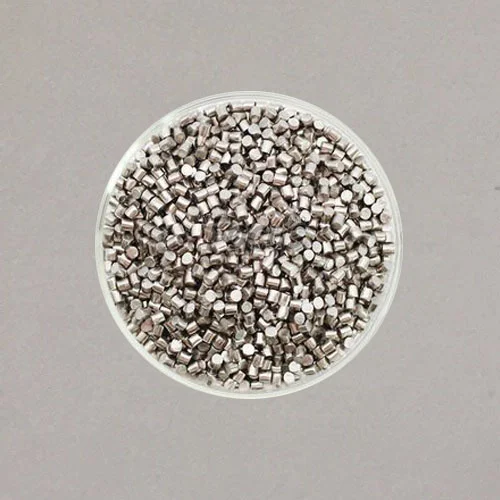
Size: 1–10 mm pellets (custom dimensions available)
Packaging: Vacuum-sealed, moisture-proof packaging
Focuswmo supplies premium-grade Titanium Pellets engineered for industries that demand exceptional strength-to-weight performance, corrosion resistance, and stable physical properties. Our Ti pellets are widely used in vacuum coating, additive manufacturing, aerospace melting, alloying, and high-temperature applications.
Titanium Pellets & High-Purity Thin Film Deposition Applications
|
Titanium pellets (often referred to as titanium evaporation pieces or granules) are small, high-purity forms of titanium metal. They are primarily engineered for high-tech material deposition processes rather than bulk structural manufacturing. |
What exactly are titanium pellets?
Titanium pellets are precisely cut, sheared, or rod-formed cylinders and spheres of titanium. Unlike generic industrial titanium scrap, these pellets are produced under strict quality control to guarantee a massive surface-area-to-volume ratio and specific material compositions.
What are the standard purity levels?
• Commercial Purity (99.5% to 99.7%): Typically used for standard hard-coatings, basic wear resistance, and less sensitive tool coatings.
• High Purity (99.9% to 99.95% - 3N to 3N5): Used in optical coatings and decorative finishes where structural integrity and color consistency matter.
• Ultra-High Purity (99.99% to 99.999% - 4N to 5N): Specifically required by the semiconductor and electronics industries to eliminate atomic impurities that could ruin microscopic circuits.
What are the typical physical dimensions?
They are usually produced in highly uniform sizes to ensure predictable melt and evaporation rates. Common specifications include 3 mm × 3 mm, 6 mm × 6 mm, and 10 mm × 10 mm.
What are titanium pellets used for?
Titanium pellets are the baseline raw material used for Thin Film Deposition. Instead of melting a massive brick of metal, engineers use small pellets to coat other objects with a micro-to-nano layer of titanium.
|
Method/Sector |
Primary Use Case |
Why It's Chosen |
|
Semiconductors |
Adhesion or barrier layers (e.g., Titanium Nitride) between silicon and copper wiring. |
Ensures microscopic logic gates operate reliably without electrical line cross-migration. |
|
Optical Lenses |
Anti-reflective, anti-scratch, and high-index coatings on lenses and mirror structures. |
Produces ultra-thin, highly uniform atomic layers without distorting light waves. |
|
Decorative & PVD |
Brilliant gold, brass, or dark grey hard finishes on consumer goods and cutting drill bits. |
Provides immense superficial wear resistance and permanent decorative color profiles. |
What are the thermal properties of titanium pellets?
• Melting Point: 1668°C (3034°F)
• Evaporation Window: Titanium typically requires temperatures between 1500°C and 1900°C under deep vacuum conditions to achieve efficient vapor deposition rates.
Do titanium pellets spit or splash during E-beam melting?
Yes, titanium is notorious for 'spitting' during E-beam evaporation. If heated too rapidly, small pockets of gas trapped inside the pellet expand violently, launching tiny molten titanium droplets at the target substrate and ruining the coating.
Operators must use ultra-high purity, vacuum-melted pellets and execute a slow, uniform 'sweep' of the electron beam to pre-melt and outgas the pellets smoothly before jumping to high evaporation temperatures.
Can titanium pellets catch fire?
Bulk titanium pellets are completely stable at room temperature and pose no fire risk. However, if the pellets are ground down or abraded into an ultra-fine powder, titanium becomes highly pyrophoric (can ignite spontaneously in air). Keep pellets intact and avoid creating fine dust during handling.
How should they be stored?
• Atmosphere: Store them in a clean, dry environment, preferably in their original vacuum-sealed or nitrogen-purged packaging.
• Contamination Control: Because they are used in atomic-layer deposition, touching them with bare hands transfers skin oils, which will outgas inside a vacuum chamber and cause deposition defects. Always handle titanium pellets using clean, oil-free tweezers or wearing powder-free nitrile gloves.
Focuswmo is a trusted supplier of titanium and refractory metal materials with strict quality control and global supply capability. We provide stable product performance, fast delivery, customized specifications, and technical support for demanding industrial applications.

+86 18625974739
focuswmo@outlook.com
High Tech Industrial Zone, Xiyuan International, Jianxi District, Luoyang City, Henan Province
 WeChat
Get a quote