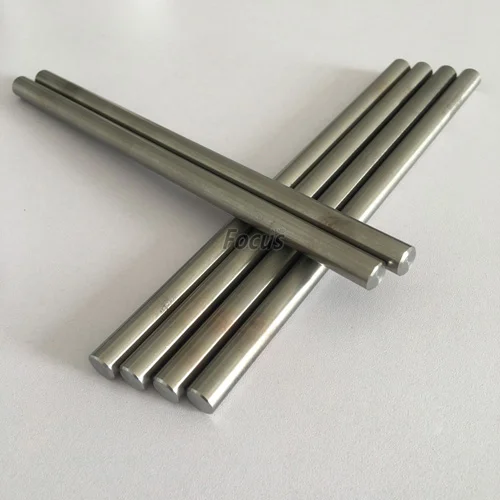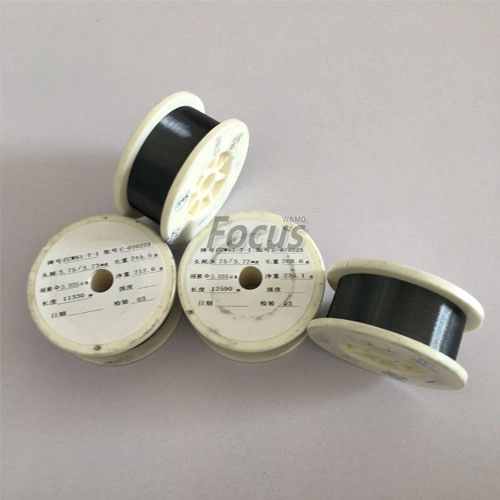
Purity: W≥ 99.95%
Density: 19.3 g/cm³
Diameter Range: 0.01mm - 2.0mm
Form: Available in straight, coiled, or spooled form
Available Types:
Pure tungsten wire
Doped tungsten wire
Tungsten-rhenium alloy wire
Coiled or straight wire
Ultra-fine micro wire
Focuswmo supplies high-purity tungsten wire with excellent high-temperature resistance, superior strength, and outstanding dimensional stability. Our tungsten wire is widely used in vacuum coating, heating elements, electronic components, and aerospace applications.
Tungsten (W) possesses some of the most extreme physical properties of all metals, making its wire form highly valuable for specialized industrial use. Key properties include:
Highest Melting Point: 3422℃ (6192℉), the highest of all non-alloyed metals.
High Density: 19.25g/cm³, comparable to gold and uranium.
Low Vapor Pressure: Maintains stability at extreme temperatures without significant outgassing.
High Tensile Strength: Exceptional structural integrity at ultra-high temperatures.
Excellent Conductivity: Highly efficient thermal and electrical conductivity.
Pure Tungsten Wire: Made from 99.95\% pure tungsten powder. It is highly efficient but can become brittle and sag after recrystallization at high temperatures.
Doped Tungsten Wire (Non-Sag / Non-Recrystallized): Small amounts of potassium (K), silicon (Si), and aluminum (Al) are added during the powder metallurgy process. This creates a interlocking elongated grain structure that prevents sagging, deformation, and premature breakage when heated to glowing temperatures.
Tungsten wire is typically supplied in three primary surface finishes:
Black Surface: As-drawn wire covered with drawing lubricants and graphite coatings.
Cleaned (White) Surface: Chemically or electrolytically washed to remove graphite and oxides, leaving a clean metallic appearance.
Polished Surface: Electrolytically polished to achieve a mirror-like finish with precise diameter uniformity.
Tungsten wire is widely utilized across a variety of demanding fields:
Vacuum Metallizing & Evaporation: Used as heating filaments or coils to evaporate thin films of aluminum, chrome, or other metals onto glass, plastics, and automotive parts.
Medical Equipment: Fine tungsten wire is used for electrosurgical electrodes (LEEP needles), ablation probes, and guidance wires due to its biocompatibility and stiffness.
Industrial Furnaces: Used as heating elements and structural grids in high-temperature vacuum furnaces.
Corona Discharge Wires: Employed in photocopiers, air purifiers, and electrostatic precipitators to ionize air.
Lighting: Traditionally used for incandescent and halogen lamp filaments (primarily doped grades).
Cut-Resistant Gloves: Tungsten wire has increasingly replaced traditional stainless steel wire as the preferred metal core in premium gloves.
Photovoltaic Cutting: As solar cells push for lower costs and higher efficiency, tungsten-core diamond wire is rapidly replacing carbon steel wire.
In vacuum evaporation processes, the wire acts as a heating element. Tungsten’s incredibly high melting point allows it to effortlessly melt and vaporize coating metals like aluminum without melting itself, while its low vapor pressure ensures it doesn't contaminate the vacuum environment or the coated substrate.
Handling, Processing, & Safety
Tungsten wire is susceptible to oxidation if exposed to moisture or harsh environments over long periods.
Store coils or spools in a dry, cool environment (ideally relative humidity < 60%).
Keep the original packaging intact until use to protect against dust and atmospheric moisture.
For clean or polished wire, handle with clean gloves to prevent oils from skin causing oxidation spots during heating.
No. Tungsten severely oxidizes in air at temperatures above 400℃(752℉), forming volatile tungsten trioxide (WO3). For high-temperature operations, it must be used in a vacuum or under a protective inert/reducing gas atmosphere (such as Hydrogen, Nitrogen, or Argon).
Tungsten is generally considered non-toxic and environmentally safe. However, safety precautions should be taken based on the specific form:
Handling fine wire: Ultra-fine tungsten wire is exceptionally stiff and sharp; care must be taken to prevent puncture wounds to the skin or eyes.
Dust generation: If cutting, grinding, or welding tungsten components creates dust, appropriate respiratory protection and local exhaust ventilation should be used to avoid inhaling metallic particles. Refer to the product's Material Safety Data Sheet (MSDS / SDS) for complete regional compliance and GHS safety handling guidelines.
Why Choose Focuswmo?
• 9+ years of tungsten & molybdenum expertise
• Complete production chain
• Fast delivery & stable quality
• OEM/ODM support
• Competitive pricing

+86 18625974739
focuswmo@outlook.com
High Tech Industrial Zone, Xiyuan International, Jianxi District, Luoyang City, Henan Province
 WeChat
Get a quote